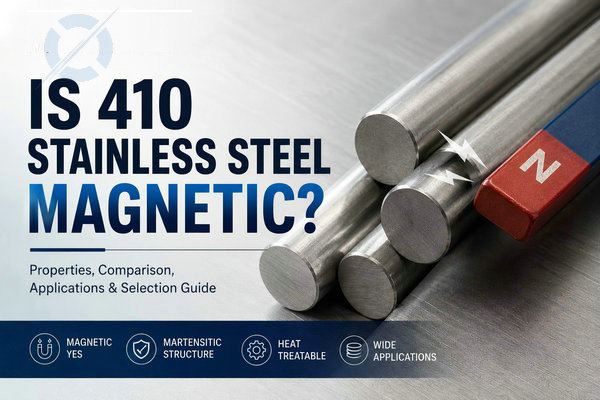
One of the most frequently asked questions we receive from buyers worldwide is: "Is 410 stainless steel magnetic?" The short answer is YES — but the full explanation reveals important nuances that directly affect material selection for your project.
In this comprehensive guide, we'll explore the magnetic properties of 410 stainless steel from the perspective of its martensitic crystal structure, compare it with 304 (austenitic) and 430 (ferritic) grades, explain how heat treatment and cold working alter magnetism, and provide practical guidance for buyers and engineers specifying materials for magnetic or non-magnetic applications.
What is 410 Stainless Steel?
410 stainless steel (UNS S41000, EN 1.4006) is a martensitic stainless steel containing approximately 11.5–13.5% chromium and a low carbon content (0.08–0.15%). It is the most widely used martensitic grade, offering a unique combination of moderate corrosion resistance, high strength, and hardenability through heat treatment.
Unlike austenitic stainless steels (such as 304 or 316), which are non-magnetic in their annealed state, 410's martensitic structure is inherently ferromagnetic due to its body-centered tetragonal (BCT) / body-centered cubic (BCC) crystal structure. This structure allows magnetic domains to align easily, making the material strongly attracted to magnets.
Key Characteristics of 410 Stainless Steel
- Magnetic: Strongly attracted to magnets in all heat treatment conditions
- Heat treatable: Can be quenched and tempered to achieve hardness up to 50 HRC
- Moderate corrosion resistance: Suitable for mild atmospheric, fresh water, and mild chemical environments
- Good machinability: Better than austenitic grades, especially in the annealed or hardened condition
- High strength & wear resistance: Ideal for cutlery, surgical instruments, valves, and pump components
Why is 410 Stainless Steel Magnetic? The Science Explained
The magnetism of 410 stainless steel is determined by its crystal structure, which is fundamentally different from austenitic stainless steels. Here's the detailed explanation:
1. Crystal Structure: Martensite (BCC/BCT)
410 stainless steel has a martensitic microstructure, which is a body-centered tetragonal (BCT) or body-centered cubic (BCC) crystal lattice. In BCC/BCT structures, unpaired d-orbital electrons in iron atoms create a strong internal magnetic field. This makes the material ferromagnetic — the same type of magnetism found in carbon steel and iron.
2. Iron Content
410 stainless steel contains approximately 83–87% iron (balance: Cr, C, Mn, Si, etc.). Iron is intrinsically ferromagnetic below its Curie temperature (~770°C / 1418°F). The high iron content ensures strong magnetic properties.
3. No Austenite Stabilizers (or very little)
Unlike 304 or 316, which contain high nickel (8–12%) that stabilizes the austenitic (FCC) structure, 410 contains little to no nickel (max 0.75%). Without nickel to stabilize austenite, the material defaults to a ferromagnetic martensitic structure at room temperature.
410 vs 304 vs 430: Magnetism Comparison
Understanding how 410 compares to other common stainless steel grades helps you make the right material selection:
| Property | 410 (Martensitic) |
304 (Austenitic) |
430 (Ferritic) |
|---|---|---|---|
| Magnetic at Room Temp | ✅ Yes (Strong) | ❌ No (Generally) | ✅ Yes (Moderate) |
| Structure | Martensitic (BCC/BCT) | Austenitic (FCC) | Ferritic (BCC) |
| Nickel Content | ≤0.75% | 8–12% | ≤0.75% |
| Heat Treatable | ✅ Yes (Quench + Temper) | ❌ No | ❌ No |
| Corrosion Resistance | Moderate | ⭐ Excellent | Moderate |
| Hardness (as hardened) | Up to 50 HRC | N/A (work hardens only) | N/A |
| Magnetism After Welding | Remains magnetic | May become slightly magnetic | Remains magnetic |
| Typical Applications | Cutlery, valves, shafts | Food processing, marine | Appliances, auto trim |
Chemical Composition of 410 Stainless Steel
The chemical composition of 410 directly influences its magnetic properties, corrosion resistance, and heat treatability. The following table shows the ASTM A240 specification limits:
| Element | 410 (S41000) Composition | Effect on Properties |
|---|---|---|
| Carbon (C) | 0.08 – 0.15% | Enables hardening by quenching; higher C = higher hardness |
| Chromium (Cr) | 11.5 – 13.5% | Provides corrosion resistance; minimum 10.5% for stainless classification |
| Iron (Fe) | Balance (~83–87%) | Primary element; responsible for ferromagnetism |
| Manganese (Mn) | ≤ 1.0% | Deoxidation; improves hot working |
| Silicon (Si) | ≤ 1.0% | Deoxidation; improves oxidation resistance |
| Phosphorus (P) | ≤ 0.040% | Impurity; keep low for toughness |
| Sulfur (S) | ≤ 0.030% | Impurity; improves machinability but reduces corrosion resistance |
| Nickel (Ni) | ≤ 0.75% | Not intentionally added; too much Ni would make it austenitic (non-magnetic) |
Source: ASTM A240 / ASTM A276 · EN 10088-1 · JIS G4303
How Heat Treatment Affects the Magnetism of 410
A common misconception is that heat treatment can make 410 non-magnetic. This is NOT possible. Here's what actually happens:
1. Annealing (Fully Softened Condition)
When 410 is annealed (heated to 830–900°C, then air-cooled or slowly furnace-cooled), it is in its softest state (~150–200 HB). It is still strongly magnetic in this condition. Annealing does not change the martensitic (ferromagnetic) nature of the alloy.
2. Quenching (Hardening)
Heating to 950–1050°C followed by rapid quenching (oil or air) transforms the microstructure into martensite. This process does not reduce magnetism — in fact, the martensitic transformation can slightly increase magnetic coercivity (the material holds magnetic domains more strongly).
3. Tempering
Tempering at 200–600°C after quenching reduces internal stresses and adjusts hardness/toughness. Magnetism remains essentially unchanged throughout the tempering temperature range.
4. What About Heating Above the Curie Temperature?
If 410 is heated above its Curie temperature (~770°C / 1418°F), it will temporarily lose its ferromagnetism and become paramagnetic. However, this effect is only temporary — as soon as the material cools back below the Curie temperature, magnetism returns completely. This is why heat treatment cannot make 410 permanently non-magnetic.
Cold Working & Its Effect on Magnetism
Cold working (rolling, drawing, bending, machining) can increase the strength of magnetism in 410 stainless steel, though it is already fully magnetic in its annealed state. Here's how:
- Increased dislocation density: Cold working introduces lattice defects that can pin magnetic domain walls, slightly increasing magnetic coercivity.
- Residual stress: Cold working induces internal stresses that can affect magnetic permeability measurements.
- Note on austenitic grades: In 304/316, cold working can induce martensite formation, making them slightly magnetic. This does NOT apply to 410, which is already fully martensitic before cold working.
Temperature Effects on Magnetism
Temperature has a predictable effect on the magnetic properties of 410 stainless steel:
| Temperature Range | Magnetic Behavior | Practical Implication |
|---|---|---|
| Below ~770°C (Curie Point) | Strongly ferromagnetic | Normal operating range; full magnetism |
| Approaching ~770°C | Magnetism gradually decreases | Do NOT use 410 above 650°C for structural purposes anyway (loss of strength) |
| Above ~770°C (Curie Point) | Paramagnetic (non-magnetic) | Temporary effect; magnetism returns on cooling |
| Cryogenic (below −40°C) | Magnetism increases slightly | No practical concern for most applications |
Practical Applications of 410's Magnetic Property
The fact that 410 is magnetic is either an advantage or a disadvantage, depending on your application:
✅ Applications Where Magnetism is Beneficial
- Cutlery & knives: Magnetic properties allow knives to be stored on magnetic strips/racks
- Valve components: Magnetic sensors can detect valve position
- Conveyor systems: Magnetic separation can remove worn 410 particles from process streams
- Electric motors & solenoids: Magnetic stainless components can be used in specific motor designs
- Fastener sorting: Magnetic response helps automate sorting of 410 parts from non-magnetic grades
❌ Applications Where Non-Magnetic is Required (410 is NOT suitable)
- MRI room components: Must be non-magnetic; use 304/316 instead
- Electronic enclosures near sensitive sensors: Magnetic interference concern
- Certain food processing equipment: Metal detectors set to detect magnetic metals may give false positives
How to Verify That Your Material is Genuine 410
Since 410 is magnetic, a simple magnet test is a quick field check — but it cannot distinguish 410 from 430 or carbon steel. For proper verification:
| Method | Can Detect 410? | Limitations |
|---|---|---|
| Magnet test | ✅ Yes (strong attraction) | Cannot distinguish from 430 or carbon steel |
| PMI (XRF) | ✅ Yes (detects 11.5–13.5% Cr, low Ni) | Portable, non-destructive, reliable |
| Spark test | ✅ Yes (long, straw-colored sparks) | Requires experience; destructive |
| Chemical analysis (OES) | ✅ Definitive | Laboratory method; most accurate |
| Hardness test | ✅ 410 can be hardened to 50 HRC | 430 cannot be hardened; distinguishes 410 from 430 |
| MTC (Mill Test Certificate) | ✅ Most reliable | Verify heat number matches material marking |
Need Certified 410 Stainless Steel?
HuaRun Metals supplies 410 sheets, coils, bars & plates with full MTC 3.1. 20+ years of manufacturing experience. Contact us for pricing & stock availability.
Get a Quote in 2 HoursFrequently Asked Questions About 410 Stainless Steel Magnetism
Yes. 410 stainless steel is magnetic in all conditions — annealed, hardened (quenched), tempered, or cold-worked. This is because its martensitic (BCC/BCT) crystal structure is inherently ferromagnetic. The only time 410 temporarily loses magnetism is when heated above its Curie temperature (~770°C / 1418°F), but magnetism fully returns as soon as it cools below that temperature.
No, this is not possible. Heat treatment (annealing, quenching, tempering) alters hardness and strength, but cannot change the crystal structure from martensitic (magnetic) to austenitic (non-magnetic). If you need a non-magnetic stainless steel, you must select a different grade: 304, 304L, 316, 316L, 321, or 347.
Both 410 (martensitic) and 430 (ferritic) are magnetic. In practice, 410 and 430 have similar magnetic attraction strength — both are strongly attracted to magnets. The difference is that 410 can be hardened by heat treatment (up to 50 HRC), while 430 cannot. For most practical purposes, both will "stick" equally well to a magnet.
No. The heat-affected zone (HAZ) from welding may locally exceed the Curie temperature, but as it cools, magnetism returns completely. The entire welded component will remain fully magnetic after cooling to room temperature. Note: welding 410 requires preheat (150–300°C) and post-weld tempering to avoid cracking — consult AWS D1.6 or your weld procedure specification.
No. MRI rooms require strictly non-magnetic materials. 410 is strongly ferromagnetic and will be powerfully attracted to the MRI magnet — a serious safety hazard. For MRI room applications, use 304 or 316 austenitic stainless steel (verify with a magnet before installation — 304/316 should show no attraction in annealed condition).
The simplest field test: use a magnet. 410 will be strongly attracted to the magnet. Annealed 304 will show no attraction (or at most a very slight attraction if work-hardened). For a more reliable test: PMI (XRF) analyzer will show 410 has 11.5–13.5% Cr and ≤0.75% Ni, while 304 has 18–20% Cr and 8–12% Ni. Also, 410 can be hardened by quenching (test with a file — hardened 410 will be very hard).
Generally not recommended. 410's 11.5–13.5% chromium provides only moderate corrosion resistance — suitable for mild atmospheric, fresh water, and some mild chemical environments, but not for continuous saltwater exposure. In marine environments, 410 will develop pitting and crevice corrosion. For marine applications, use 316 or 316L (with ~2–3% molybdenum for enhanced pitting resistance). 410 may be acceptable for intermittent marine exposure if regularly cleaned and dried.
Recommended filler metals for welding 410:
• Matching filler (ER410 / E410): When corrosion resistance and strength matching are required. Post-weld heat treatment (tempering) is essential to restore toughness and reduce cracking risk.
• Austenitic filler (ER309 / E309): When post-weld heat treatment is not possible. The austenitic weld metal accommodates the martensitic HAZ without cracking. The weld itself will be non-magnetic.
• Preheat: Always preheat 410 to 150–300°C before welding to prevent cold cracking. Intermediately after welding, keep the part warm (~200°C) until post-weld heat treatment can be performed.
Related Topics:
Stainless Steel Products Blog & News 410 Stainless Steel Sheet & Plate 304 Stainless Steel 316L Stainless Steel Carbon SteelStill Have Questions About 410 Stainless Steel?
Our technical team at HuaRun Metals is here to help. Contact us for material selection guidance, MTC verification, and competitive factory-direct pricing. We ship to 60+ countries worldwide.
Contact Our Technical Team